Are Swim Camps Too Strict? What Tough Love Really Looks Like
Short answer: The best swim camps are strict about very few things, and they are strict about them immediately. Effort in the water, lights out, and staying in your own room. That is not punishment. It is a coach refusing to watch a swimmer waste potential, followed by a conversation so the swimmer understands why. A camp that is hard on kids without ever explaining itself is a camp to avoid.
I am David Karasek, Olympian and Swiss record holder, and I am writing this from day two of our summer camp in Tenerife. Something happened in the water this morning that gets to the heart of a question parents ask me constantly before they book: are swim camps too strict, and will the coaches be too hard on my child?
Here is the full update from the pool deck. Watch it, or read on. 👇
In this article
Are swim camps too strict?
Most are not strict enough, and a few are strict about the wrong things. At a performance swim camp there should be a very short list of non-negotiables: give your real effort in the water, be in bed at lights out, stay in your own room. Everything else can flex.
The distinction that matters to you as a parent is not how hard a coach is. It is what they are hard about. We are never hard on a swimmer for failing at something difficult. We tell them before camp starts: do not be afraid of failure, that is exactly why you came. We are hard on a swimmer who we know can do more and is choosing not to. Those are completely different things, and a good camp never confuses them.
What happened on day two
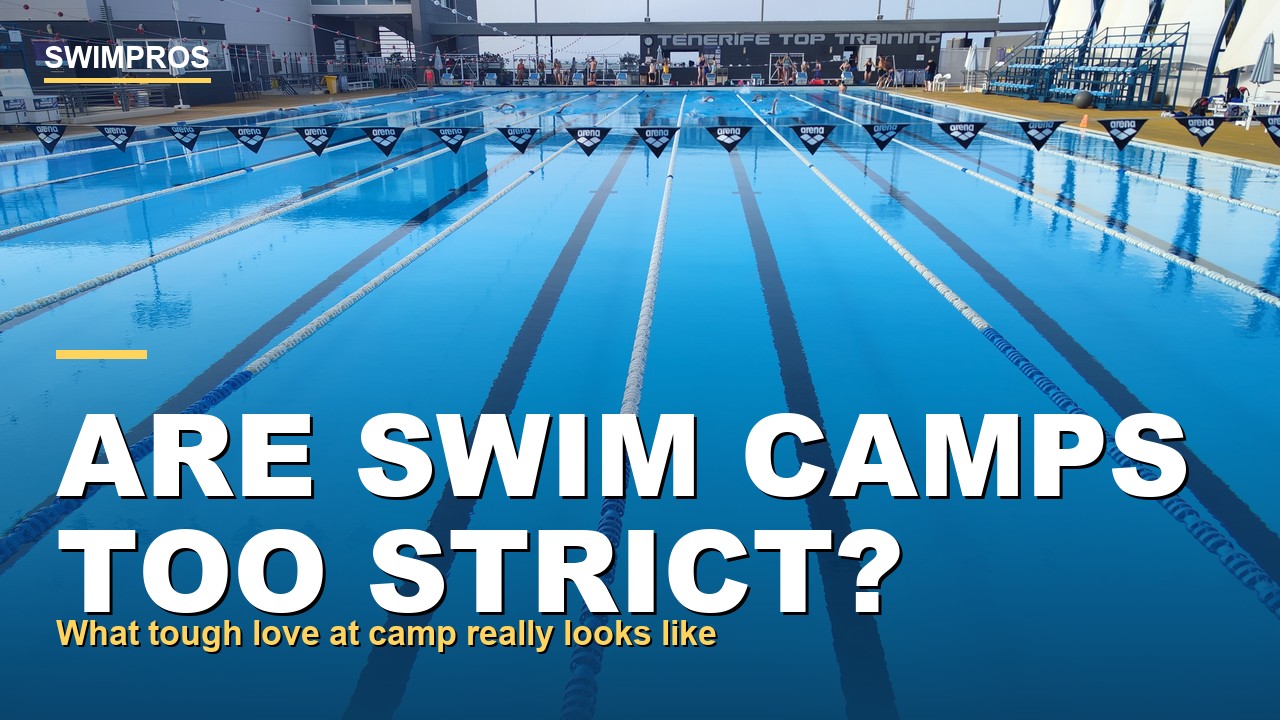
Arrival day was long. I was up at 3:45am, one group had an emergency landing in mainland Spain when a passenger fell ill, and our head coach Yul Münger was working late into the night on rooms and arrival times. By the second morning the elite and junior groups had found their rhythm at Tenerife Top Training, the high-performance centre where we run the camp, and were starting to feel the water.
Then came a breath-control set. It was meant to be hard. Instead, swimmers were arriving at the wall and talking to each other. Not because they could not do the set, but because they were choosing not to. Some were new, and with new swimmers you give it a day or two to see where their level really is. But several were swimmers we know well, and we know exactly what they are capable of.
Yul stepped in, got loud on the pool deck, and reset the standard. Then he stepped away. And it worked. The set finished the way it was supposed to.
Milorad Čavić on the underwater fly kick
Just before that set, Milorad Čavić took the group through the underwater fly kick on a whiteboard, and it was worth the trip on its own. Ask most swimmers how they actually move forward on their underwaters and they will tell you they move their feet up and down.
But moving water up and down only moves water up and down. To go forward you have to propel the water backwards, and the only moment that happens is when you change the direction of the kick. That is the whip, and it starts in the chest, not the feet. Watching an Olympic medallist and world record holder explain that to a room of teenagers, with our own coaches taking notes at the back, is the reason we bring coaches of that calibre onto the deck. If you want the longer version, I broke it down here: how to improve the underwater dolphin kick.
So the instruction was clear, the teaching was world class, and the set was still being coasted. That is a teaching moment, and it is the reason for the story I told the swimmers the next morning in our confidence session.
The day my college coach caught me cheating
Three months into my first year at the University of Virginia, we had a set that was 30 minutes of straight pain: no breathing into the wall, no breathing out of the wall. In short course yards, which was brutal for me because I had come from a 50m pool in Switzerland and underwaters were not a thing where I trained.
After about 20 minutes I could not hold it any more. I started cheating my breaths, in and out of the wall.
When the set finished, every coach had vanished from the pool deck. We sat there for two minutes wondering what was going on. Then the whole coaching staff walked back in, and head coach Mark Bernardino came straight to me, stopped, and announced to the entire team that I thought I was better than them and had decided to cheat. Then he put me on the bulkhead in the middle of the pool and made the whole team swim the entire set again while I stood and watched.
I did not know whether to laugh or cry. He was completely serious. Every time he walked past me he said the same thing: this is how we do it in America, you will learn. Thirty minutes, my teammates staring at me the whole way.
He told me months later: plenty of others were cheating that day. He picked me because he knew I could do better, and I had chosen not to.
I never cheated in and out of a wall again. That season my 200 free went from 1:53 to 1:48, and my 400 free came down to 3:52 long course and 3:46 short course. And Mark, who was ruthless with every first year for exactly this reason, became one of the people I respect most in the sport. He has coached world champions, Olympic gold medallists and world record holders. By my final year he was someone you could sit and have a beer with. He did not just make us faster swimmers. He made us adults.
Getting him onto the pool deck at camp next summer is a work in progress. We have spoken about it, nothing is settled yet, but I would be delighted.
Why the first 48 hours decide the week
Whatever you accept on day one becomes the standard for the rest of camp. That is true in the water and it is true in the hotel.
Take lights out. These are teenagers, boys and girls, away from home, enjoying each other's company. Give an inch on the first night and you get room hopping until 2am, swimmers who are dead at morning practice, and a week that never recovers. So the rules are firm from the first evening: in your own room, lights out on time. Set the tone early and the rest of camp gets easier for everybody, swimmers and coaches both.
A summer camp needs this more than our New Year's camp does. Mid-season, swimmers arrive already sharp and in competition rhythm. In summer, some are still in holiday mode when they land. That is completely understandable, and it is exactly why the first two days matter.
The line tough love should never cross
This is the part parents should actually screen for when comparing swim camps. Tough love is not a coaching style we reach for because we enjoy it. It works only when three things are true:
- The rules were agreed in advance. Everyone knows why they are here and what the process to success looks like. Our job as coaches is to help them stick to it.
- It targets choices, never ability. A swimmer who tries and fails gets support. A swimmer who can do more and opts out gets called on it.
- There is always a debrief. We sat down with the swimmers in the confidence session the following morning and talked the whole thing through. They got it. A camp that goes hard and never explains itself is not teaching anything, it is just shouting.
The reason we do any of this is that the mission is bigger than swimming. We use competitive swimming to send these kids home as better young men and women, with skills they will need long after they stop racing. Sometimes that includes tough love, occasionally very tough love, and it comes from caring about who they become. We also tell them the other half out loud, because it matters just as much: we believe in them.
Key takeaways
- Good swim camps are strict about three things only: effort, lights out, own room.
- Coaches should be hard on choices, never on a swimmer who tries and fails.
- The first 48 hours set the standard for the entire week, in the water and in the hotel.
- Always ask a camp how it debriefs with swimmers, and who supervises overnight.
- Ask who is actually on the pool deck. At our Tenerife camps that includes Milorad Čavić and Peter Mankoč.
Frequently asked questions
Are swim camps too strict?
A good camp is strict about a short list in the first 48 hours: effort, lights out, staying in your own room. Be wary of a camp that is hard on swimmers without ever explaining why or debriefing afterwards.
What does tough love at a swim camp actually mean?
Boundaries agreed in advance, a coach who calls out a swimmer capable of more, and a conversation afterwards. Never humiliation for its own sake, and never punishment for failing at something genuinely hard.
Why are swim camps strictest in the first two days?
Whatever is accepted on day one becomes the standard all week. Talking through a hard set, or room hopping on night one, costs days of training that never come back.
How are teenagers supervised at a residential swim camp?
At our Tenerife camps, staff supervise around the clock with enforced lights out and no room hopping. Ask any camp exactly who is awake overnight and what the evening rules are.
About the author. David Karasek is a Swiss Olympian (London 2012, 200m IM) and Swiss national record holder (2:01.35). He swam NCAA Division I for the University of Virginia Cavaliers under Mark Bernardino before representing Switzerland at the Olympics. He is the founder of Swimpros, Europe's most popular performance swim camp right now, where he coaches the race-day mental game alongside head coach Yul Münger.
Want to see how we coach before you book?
See the dates, the coaches and the open spots at Swimpros, Europe's most popular performance swim camp right now.
See the campMore for swim parents
🌊 Connect with Swimpros
Performance camp (swimpros.com) · Free Skool group · YouTube · Instagram · Facebook · LinkedIn