Swim Camp vs Private Coaching: Which Improves More?
Short answer: They solve different problems. Private coaching is better for slow, steady correction of one specific thing over months. A performance camp is better for a fast, concentrated reset... ten days of daily feedback, video/flume analysis, and mental training, all in one block. If a camp block is part of this season's plan, the New Year camp is the realistic window now. October sold out.
I am David Karasek, an Olympian and former Swiss record holder, and I get this question from parents weighing where to spend the budget: private lessons, or a camp? Here is the honest comparison.
In this article
What private coaching does well
A good private coach, seen weekly, can steadily correct a single flaw — a late breath, a dropped elbow, a slow turn — over a season. It's consistent, it's personal, and it fits around a normal training and school schedule. The limitation is pace: change happens gradually, one cue at a time, and most private setups don't have access to flume-style video analysis or a structured mental-performance curriculum.
What a camp does that private coaching usually can't
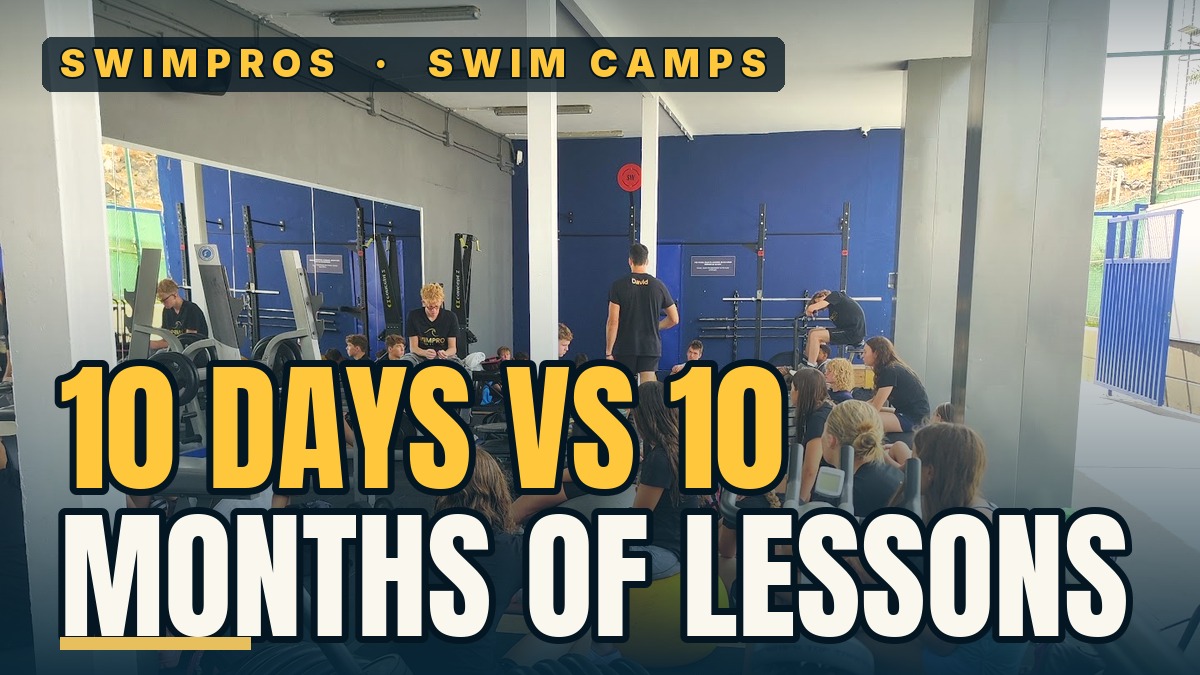
A performance camp compresses months of correction into ten days by stacking daily feedback: at Swimpros that's a 1-to-8 coach ratio in the water every session, a flume-channel video session where the swimmer actually sees the drag they're fighting, and daily mental-performance coaching for the swimmer who trains great but tightens up at meets. It also puts your swimmer around other competitive swimmers at a similar level for ten straight days, which changes effort in a way a solo weekly lesson doesn't.
How to decide
If your swimmer has one specific technical flaw and time on their side, private coaching over a season is a reasonable, cheaper path. If you're heading into a key summer of racing, stuck on a plateau, or dealing with a swimmer who's fast in practice and tight at meets, a concentrated camp block is usually the faster fix — and it's not an either/or. Many of our swimmers do both: private coaching through the season, camp as the reset.
Private coaching changes one thing at a time. A camp is built to change several things at once, fast, with proof on video.
When can you book a swim camp?
Camps run on fixed dates: the October camp (Oct 24 to Nov 1, 2026, sold out at 15 swimmers), the New Year camp (Dec 26, 2026 to Jan 4, 2027, with a Junior edition), Easter (Mar 25 to Apr 4, 2027), the Summer Taper camp (Jul 3 to 13, 2027) and three August 2027 blocks in Tenerife. Private coaching, by contrast, can usually start any week.. which is exactly the trade-off this article is about. Current availability is always at swimpros.com.
Key takeaways
Private coaching: steady, personal, best for one specific ongoing flaw.
A camp: concentrated, video/flume-backed, best for a fast reset before a key season.
80% of Swimpros campers hit a personal best during the 10-day camp itself.
Many swimmers use both — season-long private coaching, camp as the reset point.
Frequently asked questions
Is a swim camp better than private coaching?
They solve different problems — private coaching for ongoing correction, a camp for a fast, concentrated reset with daily video feedback and mental training.
Can private lessons replace a swim camp?
Rarely on their own — most private setups don't include flume-based video analysis or a daily mental-performance program.
Is a week-long camp enough to see results?
At Swimpros' 10-day camps, 80% of swimmers hit a personal best during camp, with the rest within 90 days.
About the author. David Karasek is an Olympian and former Swiss record holder in the 200m IM, and the founder of Swimpros, Europe's most popular performance swim camp right now. He coaches the race-day mental game for competitive swimmers and runs the camps in Tenerife.
Deciding between a season of lessons and a fast reset?
See what ten days at Swimpros, Europe's most popular performance swim camp right now, can do.
More for swim parents
🌊 Connect with Swimpros
Performance camp (swimpros.com) · Free Skool group · YouTube · Instagram · Facebook · LinkedIn