Swimming Video Analysis: Is a Flume Channel Worth It?
Is swimming video analysis in a flume worth it? My honest answer, after years of using the flume channel at our camps in Tenerife: yes and no. Yes for elite swimmers, no for juniors, and only if the coaches pick one thing to fix. I am David Karasek, London 2012 Olympian and former Swiss record holder, and this is what I covered in episode 42 of Swimpros News.
How does swimming video analysis in a flume work?
A flume is a small pool with a current you can set, like a treadmill for swimmers. The one we use is at Tenerife Top Training, the training center where we run the Swimpros performance camps. As far as I know, very few places in Europe have one.
The swimmer jumps in and holds on to a metal bar at the front. We tell the operator what speed to set, and it is always just above race pace. If a swimmer swims 26 seconds in the 50 freestyle, we set the current to 25.5. The operator gives the thumbs up, the swimmer lets go, drifts back about a meter and a half to a line on the bottom, and starts sprinting.
They swim as hard as they can for about 10 seconds. Because they stay on that line, the high-speed cameras above and under the water are in exactly the right spots. When they are done, they just float back with the current. The other swimmers watch through a window below the surface, and that part makes really cool videos.
We do it on day three of the camp, once the swimmers have their feel for the water back. On the same day we look at the footage with each swimmer.
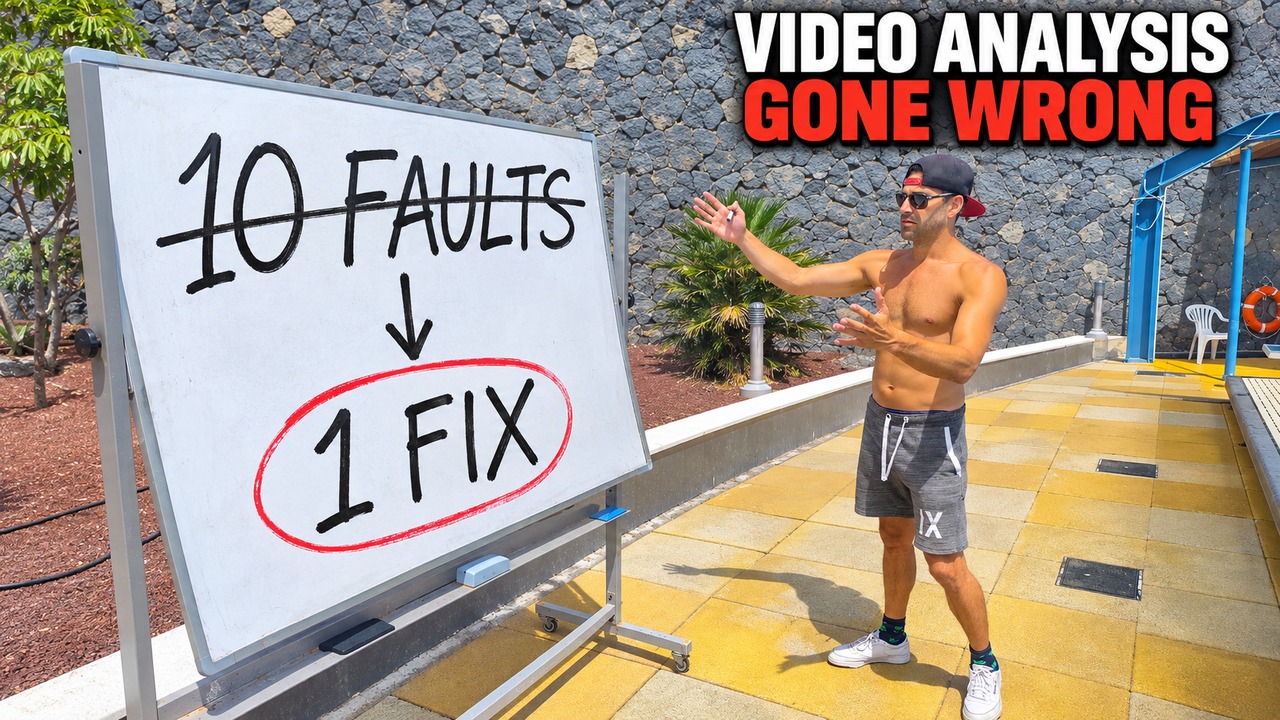
Why does showing a swimmer ten faults backfire?
When you go through high-speed footage frame by frame on a computer, you see everything. Every air bubble they pull through the water, every wrong angle.
A swimmer who sees all of that in super slow motion thinks: oh my God, I can’t swim. I know, because it happened to me as an athlete. I was told all the things that were wrong, and I walked out with my head down.
Take freestyle. Say I tell a swimmer to put the head lower, that the hands cross over, that they do not rotate enough, and that they only do four kicks at times instead of six.
No matter how focused they are, they cannot think about all of these things at the same time. They are not an octopus.
What do we do with the video instead?
The coaches may see five, ten, fifteen things that would make a swimmer faster. We pick the number one thing: the one fix that drops the most time. That is the only thing the swimmer takes out of the video session.
Then we have eight days to be 100% focused on that one thing and make it automatic. Only when it is automatic do we move on to the next most important thing. After day three, the coaches know and the swimmer knows exactly what to focus on for the rest of the camp, whatever drill we are doing. It is not easy to break an old pattern, but this makes it simple.
I wrote more about that method in how to improve swimming technique faster by fixing one thing at a time. After camp, the flume video and the coaches’ notes go into a personal report for each swimmer, with what to work on next at home.
Why do juniors skip the flume?
We do not put our junior group in the flume, for two reasons.
First, their biggest mistakes are easy to spot from the outside. The junior coaches are often in the water with their goggles on, so they see the stroke above and under water and know what each swimmer needs. A junior needs the basics, not a frame by frame analysis.
Second, when a swimmer stops, the current carries them to the back of the pool. For an elite swimmer that is part of the fun. For a small child it can be unpleasant, and we do not need it. For juniors the flume would only be for the experience, and we are better off training.
Is the flume worth it for an elite swimmer?
Yes and no. A lot of the time, the video confirms the hints the coaches already have after two and a half or three days on the pool deck.
Sometimes it shows something new, especially with sprinters. At full speed the stroke is simply too fast to see everything from the side of the pool, and then the footage is really interesting. It also gives every swimmer one-on-one time with a coach.
So I think the flume is worth it. But the most important part is not the flume. It is the video.
What is the real value of video analysis for a swimmer?
The aha moment. Telling a swimmer about rotation is one thing. In the drills we ask them to rotate more, to exaggerate until it feels stupid and weird, because that is usually exactly when they do it right. Many are a bit afraid to, because they feel they already rotate too much.
Then they see themselves on video, and they go: oh, I really only rotate that much. Now they get it. How a stroke feels in the water is often not what actually happens, and the video gives them the objective view. That gives them the courage to try something new.
There is a great book, The Inner Game of Tennis by Timothy Gallwey, and it transfers one to one to swimming. His point: you can explain a tennis swing in a thousand ways, and nothing works as well as letting the player see themselves in a mirror. Video is that mirror for a swimmer.
Most clubs do not have the resources to do this on a consistent basis. But it does not have to be a flume. A GoPro from the side and from the front does the job too.
How do swimmers train the fix after the video?
The first morning of camp is about streamline, because a swimmer uses it off every single wall, at their highest speed. If the streamline is bad, the underwaters, the breakouts and the starts are bad too. After that I remind them before every push-off, to the point where I sometimes lose my voice. More on that part in how to improve the underwater dolphin kick.
The rest of the morning is technique work. At the end of the session the swimmers apply the better technique at race pace or slightly faster. For example: three rounds of four 50s at 200 race pace, with a 200 easy between the rounds.
We also teach them to count their strokes. Say a swimmer takes 30 strokes and swims 30 seconds. If they swim the same 30 seconds with 28 strokes, they are more efficient and have more energy left for later in the race. If they keep the 30 strokes and swim 29 seconds, they got faster. Both are good. And what you measure, you can manage: just paying attention to the stroke count improves the distance per stroke.
What happens when the technique falls apart?
We stop the set for that swimmer. If after two rounds they no longer make their race pace, or the stroke count goes up, in butterfly for example by two strokes, they are done with that set. One stroke over is fine.
That is not a punishment. They held great technique for as long as they could, and now they are tired. We do not want them to go into survival mode and swim the old pattern. They practise a couple of streamlines or starts instead.
The easiest way to change a pattern is to do the new one and never do the old one again. It is like quitting smoking: you do not quit and then have just one. And as a side benefit, by the end of camp the swimmers know how to pace a 200, or the first 25 of a 100. The results of our last camp are in why 14 of 15 swimmers swam a PB at a mid-season training camp.
Does technique make the champion?
Not on its own. Bob Bowman, who coached Michael Phelps and Léon Marchand, puts it like this: the physical gifts get a swimmer in the room, and what is in the head and the heart makes the champion. I see the same thing with technique. Once a swimmer knows the one thing to fix, getting better is a matter of how focused they can stay on it.
Key takeaways
- Swimming video analysis is worth it when it ends with one fix, not ten faults.
- In the flume the current is set just above race pace, for example 25.5 for a 26-second 50 freestyle, and high-speed cameras film about 10 seconds of sprinting above and under water.
- We film on day three, pick the one fix that drops the most time, and use the remaining eight days to make it automatic.
- Juniors skip the flume: their biggest mistakes are easy to see from the deck or in the water.
- The real value of video is the aha moment, when a swimmer sees what they actually do. A GoPro from the side and the front does that job too.
- Count strokes, and stop the set when the pace drops or the stroke count goes up. Never practise the old pattern tired.
Frequently asked questions
Is swimming video analysis worth it?
Yes, if it ends with one clear fix. The value of video is that a swimmer sees what they actually do in the water, which is often not what it feels like. It backfires when the swimmer is shown every fault at once. Pick the one change that drops the most time and work on only that until it is automatic.
What is a swimming flume and how does it work?
A flume is a small pool with an adjustable current, like a treadmill for swimmers. The swimmer holds a bar while the current is set just faster than race pace, for example 25.5 for a swimmer who swims 26 seconds in the 50 freestyle, then lets go and sprints for about 10 seconds while high-speed cameras film above and under water.
Why do junior swimmers not use the flume at Swimpros camps?
Because their biggest mistakes are easy to see from the pool deck or in the water, where the junior coaches often work with goggles on. A junior needs the basics, not a frame by frame analysis, so the time is better spent training.
Can I film my swimmer myself for video analysis?
Yes. A GoPro or a phone from the side and from the front does the most important job: it lets the swimmer see themselves. Ask the club coach and the pool first, then let the coach pick one thing to work on from the video.
More for swim parents
One fix from the video, eight days to make it automatic
Swimpros runs Europe’s most popular performance swim camp right now. The elite group is filmed in the flume channel in Tenerife on day three, with a coach ratio of 1 to 10, and every swimmer leaves with the one fix that drops the most time. Peter Mankoč, former short course world record holder in the 100 m individual medley, is co-head coach of the Easter elite camp.
See camp dates and open spots | Join the free swim parent community
🌊 Connect with Swimpros
Performance camp (swimpros.com) · Free Skool group · YouTube · Instagram · Facebook · LinkedIn