How to Get Faster at Swimming Outside the Pool After Camp
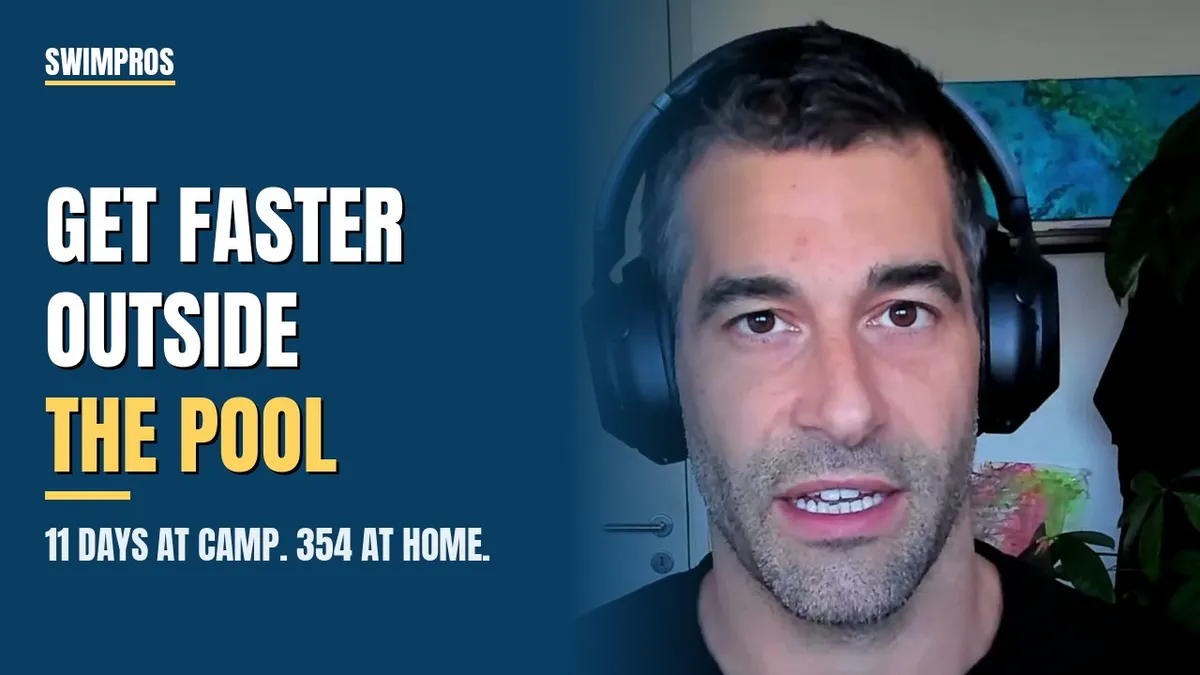
How to get faster at swimming outside the pool comes down to what happens on the days nobody films. A swim camp is roughly 11 days a year. That leaves about 354 days of training at home with the club, plus school, friends, holidays and competitions. At camp we have a luxury: all day to train the body, the technique and the mind, then recover. The camp is where the habits start. Home is where the speed comes from. Here is what I mean, with real examples from our swimmers, and the habits I want every Swimpros camper to take home.
How can a swimmer get faster outside the pool?
By changing a few small things they do every day, not everything at once. Asking a teenager to change their whole life after camp would be an unreasonable ask. At home they have school, friends, family commitments and meets. So we pick habits that are easy to do and easy to remember: mobility before practice, drinking through the day, going to bed on time. Done on most of those 354 days, they add up to far more than anything we can do in 11.
That is also the honest answer to what happens after a performance camp. At the end of a Swimpros camp every junior swimmer gets a personal best in their best race, and about 80% of the elite group do. The ones who don’t are usually the bigger, stronger swimmers who are a bit broken down after training twice a day for ten days. They swim within a few tenths of their best in the middle of a heavy block, then PB within a few weeks to three months once they rest. I wrote more about how we measure that in what to look for in a swim camp with a personal-best guarantee.
Does stretching your ankles really make you kick faster?
Yes, and it can happen fast. If a swimmer’s ankles are stiff, their fly kick, backstroke kick and freestyle kick will always be slow, which leaves breaststroke as the only stroke where it does not hold them back.
A real example. A 13-year-old private client of mine did a 400 m freestyle kick test with a board, long course: 7:50. Freestyle was her stroke and we needed a better kick, especially for her sprint. One of the things I asked her to do was stretch her ankles for one minute before every practice. Every single practice. Two months later she did the exact same test, no cheating: 6:42. That is a minute and ten seconds faster in two months.
Was it only the ankles? Who knows. She had a great work ethic, she did not skip practice and she did not get sick, so a few things went her way. But the kick started with one minute on the pool deck. If you want the full test and the stretch itself, read why ankle flexibility predicts a fast swimmer.
Why does mobility matter so much for teenage swimmers?
Because every fast swimmer I talk to does it. I look at what the pros are doing, I ask them on calls and podcasts, and mobility is one of the things they all do, and more of it than you would think. It gives them range of motion, it keeps them healthy for longer, and it helps them swim faster, which is what every family that comes to camp wants.
A teenager does not need an hour a day like Caeleb Dressel. Think about what a swimmer does when they arrive at the pool: they see their friends, say hi, and do what they have always done. That is the perfect moment to swap one useless routine for one minute that they understand and believe in. Sit on the kickboard and lift the knees. Easy.
So from now on, every Swimpros camper leaves with a personal mobility routine of 5 to 10 minutes, built around where they are stiffest. Some swimmers are stiff in the shoulders, some in the hips, the knees or the ankles. We start with the stiffest part. It is common sense, and it is short enough that they actually do it at home.
How much water should a swimmer drink on a training day?
More than most of them do, and spread over the whole day. Training once or twice a day at 25 degrees, 1.5 litres of water and nothing else is not enough. Chugging everything after practice and then drinking nothing for the next six hours does not work either.
The fix costs nothing. Wrap a piece of duct tape around the water bottle, take a marker and draw a smiley face with the words “drink me”. That is all it takes. They see the bottle and they take a sip. For race days, here is what a swimmer should drink at a meet.
Why do teenagers push back on parents but listen to a coach?
Because of the setup, not because of your parenting. Your swimmer already knows they should sleep more, drink more water, eat at the right time and spend less time on a screen. When mom or dad says it, a teenager pushes back. You were a teenager, I was a teenager, that is how it works. It is not your fault and it does not mean you haven’t figured it out.
Then a coach like Milorad Čavić or Peter Mankoč says the same thing you have said for two years, and suddenly it happens. It lands differently because we are not their parents. Nagging only leads to arguments that chip away at the relationship, and you can let us be the ones who say it. If screens are the daily fight in your house, try the no-nag screen-time deal your swimmer signs.
How do you make a new habit stick for a teenage swimmer?
Connect the habit to the swimmer’s own why. Think about the things you kept putting off before your first child was born. Then the baby arrived and you just did them, because now you had a reason. For me, my kids are that reason. When I notice resistance to something I know makes sense, I connect it to them and the resistance goes.
At camp we do the same with every new habit. Water, sleep, mobility: each one gets linked to what the swimmer wants, in a way that hits home for them. Then they feel the difference themselves. They drink more, recover better, feel less rusty in training, and they keep it going at home because now it is their idea.
I could talk to a swimmer for 30 minutes about how much mental training changed my life. It is much better to give them one tool, let them try it, and let the result do the talking.
What should a swimmer do after choking at a meet?
Here is a real one. A swimmer who is coming to camp, and who never texts me, sent this in the middle of a competition: he did a good warm-up, felt ready, started his race, felt super rusty and choked. He was not overtrained. He had just broken his best time in training by a lot.
I sent him the micro Phelps breathing technique from our free Skool community. It takes about 10 minutes to learn and about 12 seconds to use before a race, and it calms the nervous system down. Three hours later he texted again: in a 50 backstroke skins race he went from 36 to 34 seconds, and he swam 34 in every round. His words: should have asked you sooner.
That is how we teach the mental side at camp. We don’t just talk about it. The swimmers try it in training and in a race, they feel calmer and more locked in, they see a different time, and then they come back asking what else they can learn. The full technique is in the Michael Phelps 4-2-8-2 breathing technique.
How does a swimmer keep their confidence after a swim camp?
By stacking better practices at home. There is a great analogy about Michael Phelps: every practice where you do better than your usual is money in a piggy bank. Practice after practice, the money goes in. On race day you take the hammer, break it open, and it is all there.
The thing with confidence is you cannot fake it to yourself. A swimmer can put on a mask for everybody else, but if they know they have not done the work, the doubt comes from the inside. When they can say “this is how I trained before camp, this is how I train now, and I have proof”, their confidence keeps building after camp instead of fading. They come home motivated, they love swimming more, they eat and sleep better, they lead the lane and ask their coach better questions. Way more than 1% better at every practice, and it stacks up.
Key takeaways
- A camp is about 11 days. The other 354 decide how fast a swimmer gets.
- One minute of ankle stretching before every practice: a 400 m kick test went from 7:50 to 6:42 in two months.
- Every Swimpros camper now leaves with a personal 5 to 10 minute mobility routine for their stiffest area.
- Small sips all day beat chugging after practice. A taped “drink me” bottle does the job.
- Teens push back on parents because of the setup, not bad parenting. A coach can say the same thing and it lands.
- Tie each habit to the swimmer’s own why, and every better practice becomes money in the bank for race day.
Frequently asked questions
How can a swimmer get faster outside the pool?
With small daily habits they keep at home: a short mobility routine before every practice, drinking small sips of water all day, enough sleep and less screen time. Each habit works best when it is tied to the swimmer’s own reason for doing it.
Does ankle flexibility make a swimmer faster?
Yes. Stiff ankles slow down the fly, backstroke and freestyle kick. One 13-year-old swimmer stretched her ankles for one minute before every practice and her 400 m kick test with a board dropped from 7:50 to 6:42 in two months, alongside hard training.
How much water should a swimmer drink on a training day?
Training once or twice a day in warm weather, 1.5 litres a day is not enough. Spread it out in small sips through the whole day instead of chugging after practice and then drinking nothing for hours.
Do swimmers keep improving after a swim camp?
Yes. Every Swimpros junior gets a personal best in their best race by the end of camp and about 80% of the elite group do. Most of the others swim a personal best within a few weeks to three months, once they rest, and the habits they bring home keep the improvement going.
More for swim parents
Start the habits at camp, keep the speed at home
Swimpros runs Europe’s most popular performance swim camp right now. Every swimmer goes home with a personal mobility routine, habits tied to their own why, and the mental tools to race calm. Free trainings like the micro Phelps breathing technique are in our parent community.
See camp dates and open spots | Join the free swim parent community
🌊 Connect with Swimpros
Performance camp (swimpros.com) · Free Skool group · YouTube · Instagram · Facebook · LinkedIn