How Big Should a Swim Camp Be? What 140 Swimmers Taught Us
📰 The short version
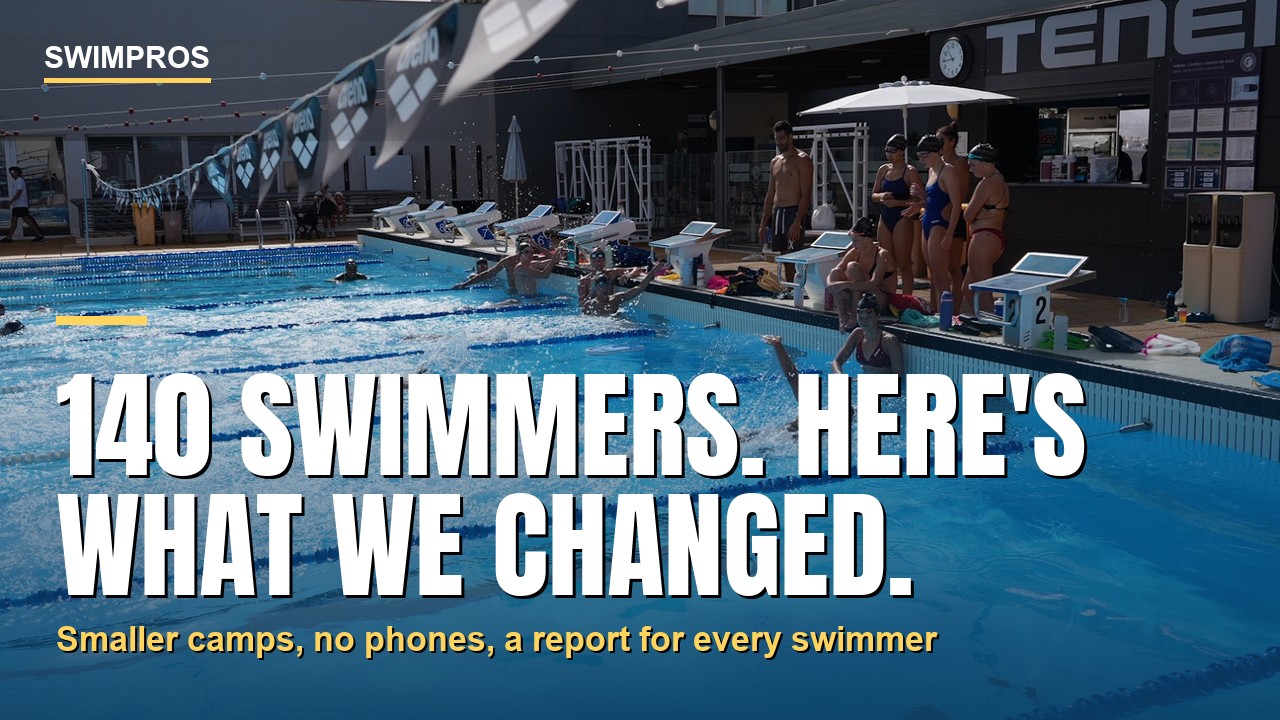
- 🏊 140 swimmers came to three Swimpros camps in Tenerife this August. It was the biggest summer we have ever had.
- 👥 The very large camps are finished. Bigger elite camps are now capped at 35 to 45 swimmers, one coach for every 10. October is 20 swimmers max.
- 🏨 A brand-new athletes-only residence next to the pool opens with the October camp.
- 📵 No gaming devices, no phones during the day. Phones come back for an hour or so in the evening.
- 📄 Every swimmer now goes home with a personal coach report, built from recorded observations and the flume analysis.
A performance swim camp works best with 35 to 45 swimmers and one coach for every 10. That is the biggest lesson from this August, when 140 swimmers trained at three Swimpros camps in Tenerife: one junior camp and two elite camps. The results were brilliant, and some of the personal bests surprised even me. But with that many swimmers on deck, I couldn’t learn every name, and there wasn’t enough one-on-one time. So we changed things.
I’m David Karasek. I swam the 200m IM at the London 2012 Olympics and I still hold the Swiss record (2:01.35). In the first Swimpros News of the 2026/27 season I walked parents through everything that changes at camp after the biggest summer yet. Watch the live below, or read the parent’s version. 👇
👥 How many swimmers should a swim camp have?
Between 35 and 45, with a coach for every 10 swimmers. That is our answer now, and it comes from experience rather than theory.
This summer we had a big coaching team on deck, including world record holders Milorad Čavić and Peter Mankoč. Everyone knew exactly what they were doing. The problem wasn’t the coaching. It was the numbers. When a camp gets very large, coaches spend the first days learning names instead of fixing streamlines, and every swimmer gets a thinner slice of attention.
So from now on:
- Our bigger elite camps are capped at 35 to 45 swimmers, with four to six coaches.
- The Rocktober camp, starting 24 October in Tenerife, is capped at 20 swimmers. It will feel completely different from the summer: small, intimate, and the coaches will know every swimmer inside out. And it still has places.
A ratio of 1-to-10 lets a coach see every swimmer every set, and yes, push them hard too.
🏨 Where do swimmers stay at a Swimpros camp now?
In a brand-new, athletes-only residence at Tenerife Top Training, about a four-to-five-minute walk from the pool. It opens on 1 October, and the Rocktober camp is the first Swimpros group to move in. From then on, every residential Swimpros camp in Tenerife stays there.
- Rooms of two, three and four. Girls with girls, boys with boys, then grouped by age.
- An athlete-focused dining hall. Honestly, this is probably the biggest upgrade. The hotel we used before was full of tourists, and the food was never quite built for athletes.
- Athletes only. No holiday crowds. You might share the building with a football or tennis squad, but everyone there is training.
- Air-conditioned rooms and hangout areas, and the coaches stay in the same building, so residential swimmers have Swimpros supervision around the clock.
If your teenager is ready to stay on their own, our guide to choosing a residential swim camp for a serious teen goes deeper.
👶 Why do junior camps stay non-residential?
Because for juniors, the priorities are technique and fun, and young swimmers are better off sleeping where their parents are. Junior camps run as drop-off and pick-up, morning and afternoon, and you get the evenings with your kids. Families get the best of both: a proper training camp and a family holiday in the sun.
I always watch for the first couple of days before I say anything. On day one this August, some of the junior strokes made me wonder how we would pull it off. Two days later, they were swimming so much smoother, with a far better body position in the water. By the end of camp I barely recognised them in the water (they were still just as loud, though). And every junior swam a personal best.
The credit goes to our junior coaches. Teaching a strong swimmer to get faster and teaching a young swimmer the basics of butterfly or breaststroke are two different skills, and they are better at the second one than I am. Their key decision was to split the juniors into mini groups by level. A 12-year-old who is almost ready for the elite group and an 8-year-old still fighting their butterfly shouldn’t do the same set. Once the groups were split, the results followed.
📵 Are phones allowed at swim camp?
Not during the day. This is a new rule at every Swimpros camp:
- Gaming devices and tablets stay at home. Ideally they don’t even get packed.
- Phones are collected for the day and the night. In the evening, if there is no team game or challenge planned, swimmers get their phones back for 60 to 90 minutes.
- Coaches always have their phones on loud. This isn’t about cutting swimmers off from home or school. If they need a phone, they get it.
“We’ve tried this with the phone many times. It just works best when they’re not on their phones. They’re social, they’re focused, they’re present, and they recover better.” David Karasek
We’ve seen what happens at night when the phone stays in the room: games, a hundred messages, not enough sleep. Families don’t send their swimmer to Tenerife to scroll through TikTok in a hotel room. If screen time is already a fight at home, the No-Nag Method is a gentler way to start.
📄 What do swimmers take home after camp?
A personal PDF report and a 90-day game plan. This is the part I’m most excited about, and as far as I know, no other camp does it.
The idea came from a simple problem. Camp lasts 10 days, and so much happens: 15 minutes of flume analysis with one swimmer, 15 with the next, dozens of small corrections on deck. It is impossible for a swimmer, or a coach, to remember it all. So I built an app with AI that every coach carries on their phone:
- A card for every swimmer, a bit like a football sticker: face, personal bests, the wishes parents send us before camp, and anything to be careful with, like allergies.
- Voice notes on the spot. Say we’ve talked about streamline all morning, and in the afternoon one swimmer is still pushing off the wall like a banana. The coach records what they see, it is transcribed, and it lands in that swimmer’s file. Every coach sees it at the next session.
- The flume analysis and the mental sessions are recorded too, then transcribed and summarised automatically.
At the end of camp, all of it becomes a personal report for the swimmer and the parents: what the coaches observed, what to focus on over the next 90 days, and resources picked for that swimmer. If a swimmer tells me on the walk back to the hotel that they get nervous before races, their report points them to the 4-2-8-2 breathing technique made famous by Michael Phelps, so they have a tool ready for their next big race. It is also something your swimmer can show their club coach.
🏆 Did the swimmers actually get faster?
Yes. Across our camps, 80% of elite swimmers swim a personal best in their main race at the end of camp, and 100% of the juniors did this summer. And 100% of our swimmers PB within 90 days of camp. That is why every camp comes with the personal-best guarantee: a personal best at camp or within 90 days, or we coach your swimmer free for six months. In four years, nobody has claimed it.
Why doesn’t everyone PB at the end of camp? Picture a strong 18-year-old, 85 or 90 kilos, after 10 days of double sessions. He needs rest before his best race. What surprises people is how many swimmers do PB when they should be exhausted. I believe the difference is the mental work.
A swimmer can train three things, and only three: the body (fitness and strength), the technique (catch, turns, underwaters) and the mind. Most clubs train the body well. Technique is hit and miss, because big squads rarely get individual attention or flume analysis. And the mind is missing for most swimmers. That is why so many swimmers train well and then don’t race to their level, lose motivation, and some quit. It doesn’t have to go that way.
🏠 Why does what happens at home matter more than camp?
Because camp is 10 days, and the season is the other 355. The motivation boost after camp is real, but like every great experience, it fades into the background after a few weeks. What keeps a swimmer improving is what they do every day at home: the habits, the way they handle a bad race, the way they stay calm under pressure.
That is why camp is the first step into the Swimpros world, and our year-long Swimpros Academy is where the real work happens: a live mentoring session with the swimmers every Sunday (goal setting, visualization, breathing, how confidence is built and lost), a monthly parent mastermind on competition nutrition, sleep, screen time and even car-ride prep, plus one-on-one support. Enrolment closed when the season started on 13 September and reopens around Christmas. In the meantime, the free Swimpros Skool group is open to every swim parent.
📌 Also from this episode
- The camp calendar: Rocktober (from 24 October), New Year’s camp (warm, sunny, heated pool, a great family break) and three summer camps from early August into September.
- 59 five-star Google reviews, with photos and videos from parents, if you want an opinion that isn’t mine.
- More families now come by referral than ever before, as swimmers bring their clubmates.
- A new kit provider after this summer’s delivery problems: tank tops, tees in white and black, and a hoodie we keep as a gift for swimmers coming back for a second camp.
🔑 Key takeaways
- Bigger Swimpros elite camps are capped at 35 to 45 swimmers with a 1-to-10 coach ratio. October is 20 swimmers max.
- Residential swimmers now stay in an athletes-only residence next to the Tenerife Top Training pool, with coaches in the same building.
- Junior camps stay non-residential and split swimmers into mini groups by level.
- No gaming devices, and phones only for a short window in the evening.
- Every swimmer goes home with a personal coach report and a 90-day game plan.
- Camp is 10 days. The other 355 decide whether a swimmer keeps improving.
❓ FAQ
How many swimmers are at a Swimpros camp?
The bigger elite camps are capped at 35 to 45 swimmers with one coach for every 10. The October camp in Tenerife is capped at 20.
Are phones allowed at Swimpros swim camps?
Gaming devices and tablets stay at home. Phones are collected for the day and night and handed back for 60 to 90 minutes in the evening. Coaches keep their phones on loud, so parents can always get through.
Where do swimmers stay at a Swimpros camp in Tenerife?
From October 2026, residential swimmers stay in a brand-new athletes-only residence a few minutes’ walk from the Tenerife Top Training pool, in rooms of two to four, with coaches in the same building. Junior camps are non-residential.
What do swimmers take home after a Swimpros camp?
A personal PDF report built from the coaches’ recorded observations, the flume analysis and the mental sessions, with what to work on over the next 90 days and resources chosen for that swimmer.
More for swim parents
Want your swimmer in the next group?
Swimpros is Europe’s most popular performance swim camp right now. The Rocktober camp is capped at 20 swimmers, and New Year’s and summer fill up fast. Have a look, then message me on WhatsApp. It comes straight to my phone.
See the camps Join the free Skool group🌊 Connect with Swimpros
Performance camp (swimpros.com) · Free Skool group · YouTube · Instagram · Facebook · LinkedIn