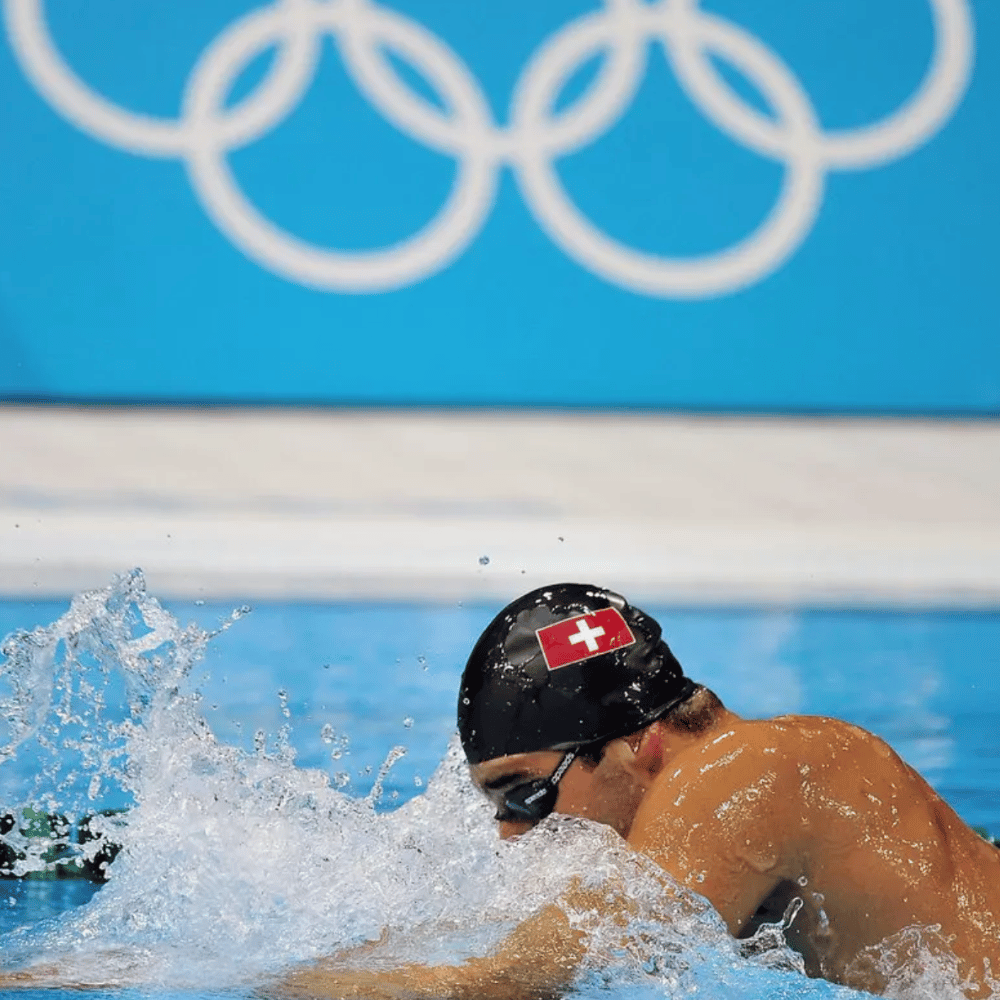
Why Are Swimmers Faster in Relays Than in Individual Races?
Every swim parent has seen this. In the morning your swimmer has an individual race, they are trying to qualify for something, and they blow it because there is so much pressure. In the evening of the same day they swim the same event in the relay, and they crush it. Here is why, what the research says, and how swimmers can take that relay feeling into every race.
Why are swimmers faster in relays than in individual races?
Ask your swimmer a simple question: where is there more pressure, when you race on your own or when you race for a team? In a relay you swim for your teammates. Depending on where you swim, you also race for the parents, for the other children’s parents, maybe for a whole nation. The honest answer: the relay.
So, paradoxically, swimmers should be slower in a relay than in an individual race. It is not like that. Of course there are exceptions, but most swimmers are faster on the relay. That is counterintuitive if the pressure is higher, so the real question is why.
The reason is that a relay is not about ourselves. It is about the others: the other swimmers, the team, maybe the nation. When we stop making it about ourselves and make it about other people, we get out of our own way.
Where is there more pressure, in an individual race or in a relay? It’s in the relay. So paradoxically, swimmers should be slower in a relay. But most are faster, because it’s not about ourselves. It’s about the others.
What does the research say about the relay effect?
This is not only something coaches notice on deck. Social psychologists Joachim Hüffmeier and Guido Hertel studied it at the highest level in a paper called “When the whole is more than the sum of its parts: Group motivation gains in the wild” (Journal of Experimental Social Psychology, 2011).
They looked at 64 swimmers from 21 countries who swam both the individual and the relay freestyle, over 100m or 200m, at the 2008 Olympics, and compared their times. The swimmers who led off the relays performed at a similar level to their individual races. The swimmers on the later legs were faster in the relay than in their individual heats.
In a pilot study, competitive swimmers reported feeling more indispensable to the team the later they swam in the relay. That lines up with what I see in young swimmers: the more a swimmer feels the team needs them, the more they give.
One honest note for parents who like to compare splits. Every leg after the first starts with a relay takeover, which is quicker than starting from a still position on the block. So do not read every fast relay split as pure motivation. If you want a fair comparison, look at a lead-off split against the individual swim from the same meet.
Why does making it about others take the pressure away?
Think about what goes on in a swimmer’s head before an individual race they care about. “Now it has to work out. I have to. I have to.” And right behind it: “Well, what if it doesn’t?” That loop is what tightens them up on the block.
When the race is about the team, that loop has nothing to hold on to. The pressure does not shrink on paper, it just stops being personal, and it goes away almost by magic.
If your swimmer is fast in practice and slower at meets, this is often the same pattern from another angle. We went deeper on that in why competitive swimmers underperform at meets.
How can a swimmer bring relay speed into an individual race?
Making it about other people and getting out of your own way does not happen by accident. It needs to be practised. One of the best ways I know is to become a leader, because leading is making it about other people.
I recently told one of the older swimmers coming to camp that I needed him to be a good team leader. He was flattered that I thought of him as a leader. What I told him is what I tell every swimmer: being a leader is not a role that somebody gives you. Being a leader is a way of living. You do not have to wait until someone older or someone with authority appoints you. You choose it.
If you do not know how to lead yet, you will figure it out, as long as you set the intention. The easiest place to start is supporting others. It gets you out of your own way and makes everybody else’s day a bit brighter. Then the mission is already completed.
There are many ways to do that, on your own terms:
- If you are a complainer, stop complaining.
- If you are very quiet, start motivating someone else. Give a teammate a pat on the back.
- If you go to bed late, go to bed on time so you have more to give in training.
The second piece is the clock. We always say in training that we want to do everything we can to be 1% better. It does not sound very exciting, but it stacks up over weeks, months and, if you can stretch the horizon, years. You cannot always look at the time, which is why swimmers need process goals as well as time goals. A swimmer chasing a process goal is already thinking less about “I have to”.
What should parents say when a big race goes wrong?
If it goes well, great, kudos and congratulations. If it does not, it is not the end of the world. Disappointments are always going to happen. They have already happened and they will happen again, and the more ambitious a swimmer is, the more disappointments they will naturally have.
So the goal is not to avoid them. The goal is to know what to do when they come, because they are part of competitive swimming and part of being a human being. Even us adults are disappointed all the time. It breaks my heart when I see a 12 or 13 year old, or even younger, crying after missing a PB by two tenths. It is not supposed to be that way, and it is a skill we can teach.
If you are unsure what to say in that moment, our guide on helping your swimmer handle race-day pressure has more on what to say and what to leave unsaid.
How do we train this at Swimpros camps?
We make it a priority on camp. New place, new coaches, lots of swimmers they have never met, so a bit of social nerves is normal. That is why the first session has a team challenge. Once they are all in the water, coaches motivated, swimmers motivated, sharing the same passion for competitive swimming, the barriers fall away. Before you know it they become friends and start to support each other.
That is the relay effect on purpose. Swimmers who are used to cheering for the next lane carry that into their own races. Alongside it we do mental training on how to handle disappointment, and we ask every swimmer before camp what they want to get out of it, and what they could do for other people while they are there.
It is the same principle we coach by. It is not about me and it is not about Swimpros. It is about where the swimmer is right now, what they want, and how we help them get there.
Key takeaways
- A relay has more pressure on paper, yet most swimmers are faster in it, because the race is about the team, not about themselves.
- Hüffmeier and Hertel (2011) found that Olympic swimmers on the later relay legs swam faster than in their individual races, while lead-off swimmers swam about the same.
- The “I have to” loop is what tightens swimmers up. Making it about others switches it off.
- Leadership is a way of living, not a role someone hands out. Supporting teammates is the easiest place to start.
- Chase 1% better and process goals, not only the clock.
- For a fair split comparison, use the lead-off leg. Takeover starts are quicker than a start from the block.
Frequently asked questions
Why are swimmers faster in relays than in individual races?
Because in a relay the race stops being about the swimmer. On paper a relay carries more pressure, because you swim for teammates, a club or even a country. But when the focus moves from yourself to the people you swim for, the inner voice of “I have to, I have to” goes quiet, and swimmers get out of their own way.
Is there research showing swimmers swim faster in relays?
Yes. Joachim Hüffmeier and Guido Hertel (Journal of Experimental Social Psychology, 2011) compared 64 swimmers who raced both individual and relay freestyle at the 2008 Olympics. The lead-off swimmers performed at a similar level to their individual races, while swimmers on the later legs were faster in the relay. A pilot study linked this to how indispensable swimmers feel to the team.
How can my swimmer bring relay speed into individual races?
Make it about other people. Support teammates, take a leadership role in the group, and set process goals instead of staring at the clock. When a swimmer is used to thinking about others, the pressure of an individual race has less to grab on to.
Can I compare a relay split directly with an individual time?
Not one to one. Every leg after the first starts with a relay takeover, which is quicker than a start from a still position, so part of a fast relay split is the start. The lead-off leg is the fairest comparison with an individual swim, because it starts the same way.
More for swim parents
Help your swimmer race every event like a relay
Swimpros runs Europe’s most popular performance swim camp right now. Team challenges from the first session, mental training built into every day, and coaches who care about the person as much as the swimmer.
See camp dates and open spots | Join the free swim parent community
🌊 Connect with Swimpros
Performance camp (swimpros.com) · Free Skool group · YouTube · Instagram · Facebook · LinkedIn