How to Help Your Swimmer Handle Race-Day Pressure
🧠 What you'll take away as a swim parent:
⚡ Why your swimmer doesn't choke because of pressure, but because of one quiet thing they tell themselves about it.
🔁 The threat-vs-challenge reframe that separates the kid who freezes from the kid who delivers, with the exact words for each.
🚫 Why trying to remove your swimmer's pressure usually backfires, and what to do instead.
🗣️ 3 things you can say before a big race that calm your swimmer without lying to them.
🏅 What I learned about pressure standing behind the blocks at the Olympic Games, that I wish someone had told my parents.
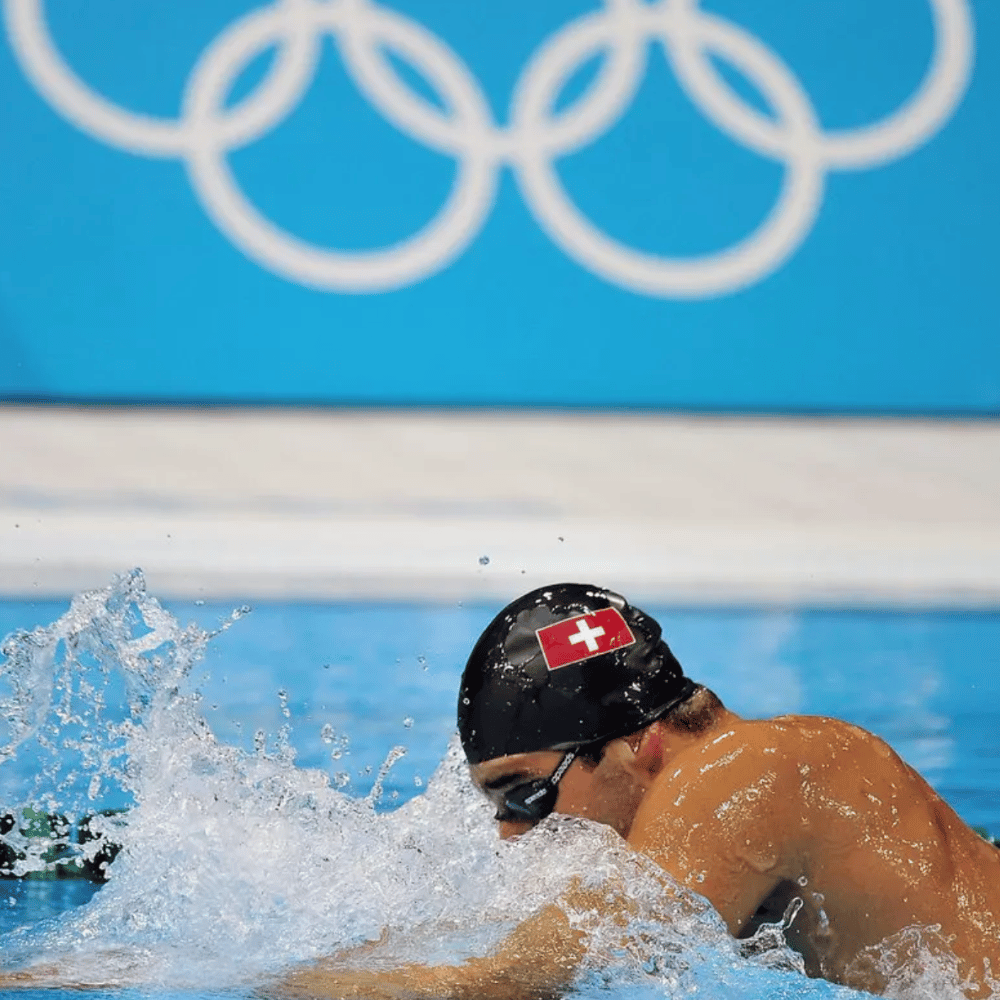
Here's something most swim parents get backwards: pressure is not your swimmer's enemy. I swam at the Olympic Games and held a national record, and I can promise you the pressure never went away, not once. The swimmers who win on the big day aren't the ones who feel less. They're the ones who've learned to read the feeling differently.
Your swimmer trained for months for a race that lasts under a minute. Of course it feels heavy. The race matters, the goal matters, and they earned that lane. So the question is never how do I get rid of the nerves. It's a much better question, and it's the one I'll hand you below. 👇
⚡ Why does my swimmer choke under pressure?
Almost always, it's not the pressure itself. It's the story your swimmer wraps around it in the ninety seconds behind the blocks. The exact same racing heart and tight chest can mean two completely different things, depending on how a swimmer reads it.
One swimmer reads those nerves as a threat:
➡️ “If I mess this up, everyone will see it.”
➡️ “I don't belong in this heat.”
➡️ “What if I lose?”
The other swimmer reads the identical feeling as a challenge:
➡️ “This is exactly what I trained for.”
➡️ “That girl is flying, perfect, let's give her a race.”
➡️ “I earned these nerves, now stand up and deliver.”
Same body. Same heart rate. Two completely different swims. The threat brain tightens up, plays it safe, and swims not-to-lose. The challenge brain stays loose and attacks. And here's the part that matters for you: the frame is a skill, which means it can be taught and trained, just like a turn or a breakout.
Pressure shows up because something meaningful is on the line. You don't earn the lane and then get to skip the nerves. The nerves are the receipt. Teach your swimmer to read them as proof they're ready, not proof they're in trouble.
🚫 Can you remove the pressure for them? (Please don't try)
The instinct every loving swim parent has is to shrink the moment: “It's just a swim, don't worry about it, no big deal.” I understand it completely. But when you tell a swimmer the race doesn't matter, two things happen. One, they don't believe you, because it obviously does. Two, you accidentally tell them their nerves are a malfunction, something to be embarrassed about.
The stronger move is to normalize and reframe: “Yep, you're nervous, that's because you care and you're ready. Let's use it.” That one sentence does more than an hour of reassurance. This reframe is one of the first things we drill with swimmers inside the free Swimpros Skool group, and we go even deeper on it at the Swimpros Performance Accelerator, Europe's most popular performance swim camp right now, where swimmers rehearse racing under real pressure on purpose.
🗣️ 3 things to say before your swimmer's big race
Keep it short and calm. You're not coaching, you're framing:
1. “You've already done the hard part.” Points them back at the months of training, not the next sixty seconds.
2. “Those nerves mean you're ready.” Turns a threat signal into a challenge signal.
3. “Go have fun racing fast people.” Strips the ‘event' status off and puts them back in play.
🔑 Key takeaways
Pressure isn't the problem, the swimmer's interpretation of it is.
Threat framing tightens; challenge framing frees. Both come from the same nerves.
Don't shrink the moment, normalize the nerves and reframe them as readiness.
The reframe is a trainable skill, not a personality trait.
❓ Swim parent FAQ
My swimmer is great in practice but freezes at meets. Is that pressure?
Usually yes, and it's incredibly common, even at the elite level. The fix isn't more yardage, it's training the swimmer to reinterpret race-day nerves and to practice racing under pressure, not just swimming fast when it's safe.
At what age should we work on this?
As soon as your swimmer is racing and caring about results, the framing skill helps. Younger swimmers especially benefit because they haven't yet locked in a ‘nerves mean danger' habit.
How do I help without becoming the source of pressure?
Stay on the frame, not the outcome. Talk about effort, readiness and fun, never about times or place. Let the clock be the coach's job.
Want help building this with your swimmer?
Inside the free Swimpros Skool group I share the exact tools I used to go from choking at college nationals to racing at the Olympics, plus a community of swim parents and competitive swimmers working on the same thing. It's free, and it takes 30 seconds to join.
Join the free Swimpros Skool group →
Your swimmer is going to feel pressure for as long as they keep racing things that matter. The goal was never to make it disappear. The goal is to put it to work. 🟡More for swim parents